LiveMetric

Visit Website

LiveOne 1m1p: Clinical-grade 4-sensor radial artery tonometry system with companion tablet for continuous blood pressure monitoring

Tech Tonometry
FDA 510(k)
Interview Kelly Benning, President
Founded 2020
Company Overview

LiveMetric S.A. operates from Luxembourg developing mechanical tonometry technology for continuous blood pressure monitoring, positioning between consumer wearables and hospital-grade equipment.

Founded in 2020, the company received FDA 510(k) clearance (K201302) in May 2022 for their LiveOne LM1P system. CEO Tomer Bentzion leads a team of 15-20 focused on R&D and clinical validation. President Kelly Benning oversees commercial strategy, stating: "We're not trying to be the next Apple Watch. We're building a medical device for patients who need clinical-grade blood pressure monitoring."

The company holds multiple patents on sensor array configurations and signal processing algorithms filed between 2019-2022. Their advisory board includes cardiologists from Columbia, NYU, and Northwestern who conducted the clinical validation studies.

Technical Specifications
4
Sensors
90s
Measurement
±5
mmHg
80mAh
Battery
IP22
Rating
BT4.0
Protocol
Core Technology
4-Sensor MEMS Array Architecture
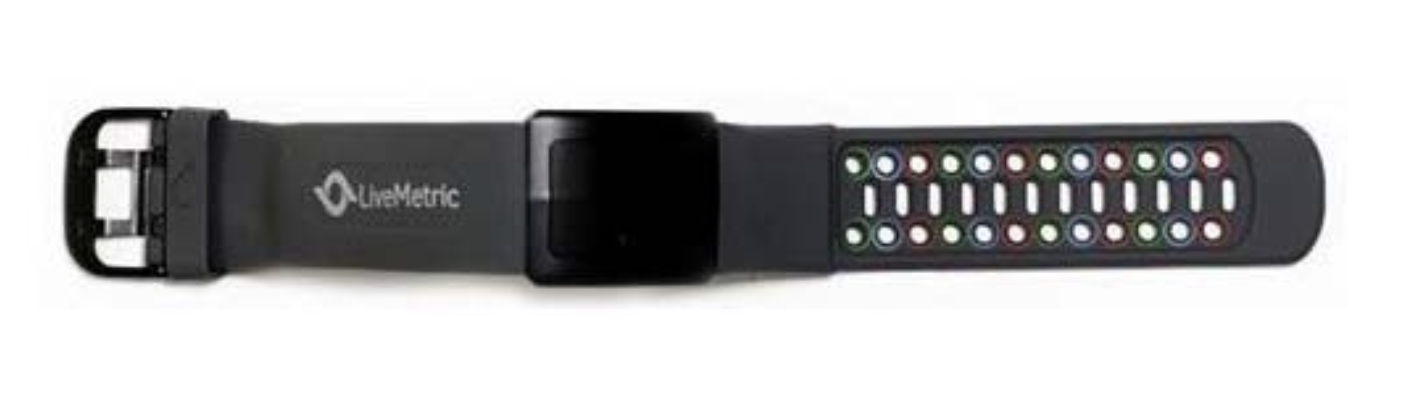
The device uses four independent MEMS pressure sensors embedded in a silicone membrane, each sampling at 100Hz. These sensors apply 40-60mmHg pressure to flatten the radial artery against the radius bone, directly measuring transmural pressure. When sensor 1 loses signal from wrist movement, sensors 2-4 continue monitoring. The tablet displays all four waveforms simultaneously - green indicates signal quality above 85%, yellow 60-85%, red below 60%. This redundancy solves tonometry's biggest limitation: maintaining arterial applanation during daily activities.
Signal Processing Pipeline
Raw waveforms undergo three stages: First, a 3-axis accelerometer (LSM6DS3) identifies motion artifacts in real-time, filtering frequencies above 20Hz. Second, the algorithm segments waveforms into cardiac cycles using derivative analysis to identify systolic upstroke and dicrotic notch. Third, a proprietary ML model trained on 10,000+ arterial line recordings extracts BP values from waveform morphology. Patient demographics (age, sex, height, weight) adjust for arterial stiffness. Final values average 6+ consecutive beats, discarding outliers beyond 2 standard deviations.
Hardware Specifications
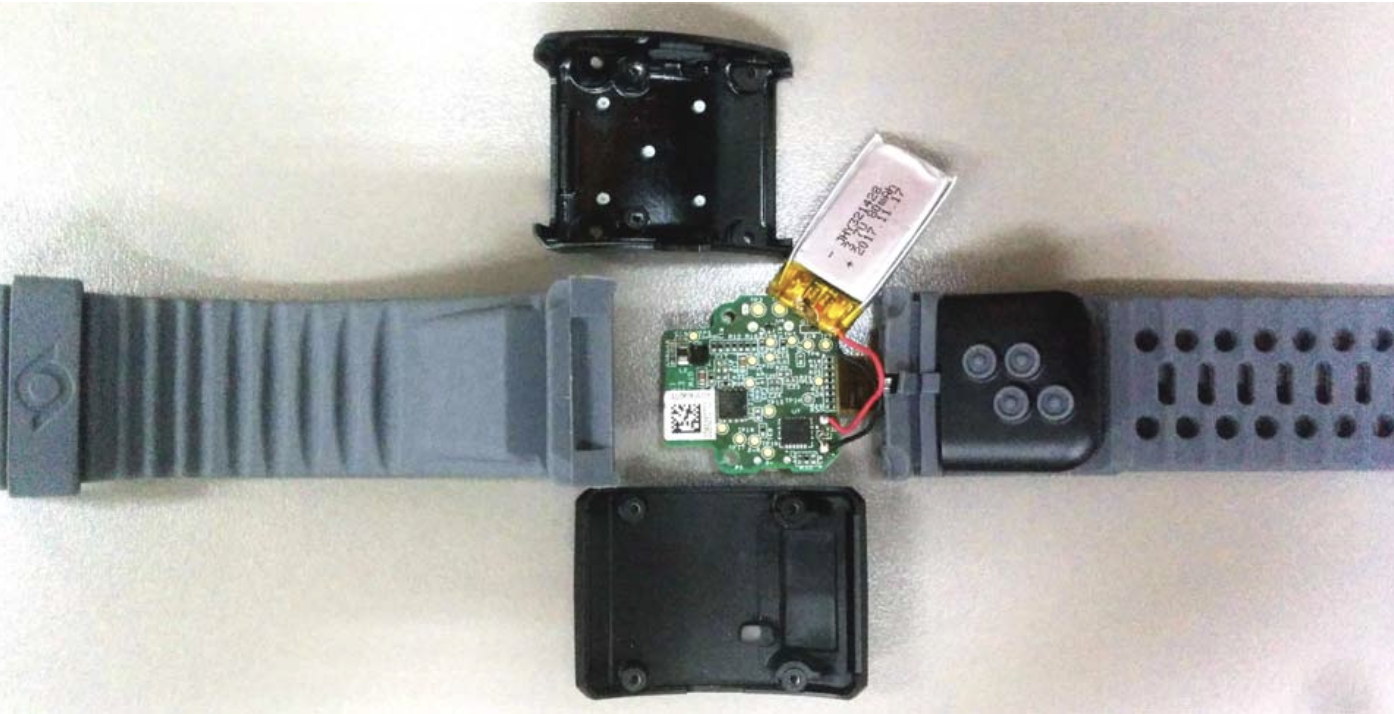
Nordic nRF52832 microcontroller (64MHz ARM Cortex-M4) with 512KB flash handles onboard processing. Bluetooth 4.0 operates at 2.402-2.480GHz with -92dBm sensitivity, 10-meter range. The 150mAh lithium-polymer battery provides 24-48 hours continuous monitoring, 7 days standby. Device measures 45x38x14mm, weighs 42g. Silicon 60 Shore A elastomer strap fits 155-210mm wrists. The companion Microsoft Surface Go runs Windows 10 with proprietary LiveMetric software requiring 4GB RAM minimum.
Measurement Protocol
Each measurement requires 90-second data collection after 5-minute rest period. The device operates in three modes: Single Mode (one-time measurement), ABPM Mode (programmable intervals 10-60 minutes), and Continuous Mode (real-time waveform display for clinicians). Measurements fail if patient moves (accelerometer threshold >0.5g), if all sensors lose contact for >3 seconds, or if heart rate variability exceeds 20%. The system logs timestamp, signal quality score (0-100), and rejection reason for failed attempts.
Clinical Performance
0.91
SBP Correlation
vs Arterial Line
0.85
DBP Correlation
vs Arterial Line
98%
Within 15mmHg
Systolic Accuracy
233
Measurements
Multi-center Trial
Multi-Center ICU Study (n=26)
Columbia, Northwestern, and NYU enrolled 26 ICU patients with radial arterial lines. The study collected 154 measurement periods comparing LiveOne to invasive reference. Results: systolic bias 0.7±6.6mmHg (95% CI: -12.2 to 13.6), diastolic bias 2.0±5.5mmHg (95% CI: -8.8 to 12.8). The device met ISO 81060-2:2018 criteria requiring ≤5mmHg mean error with ≤8mmHg standard deviation. Importantly, accuracy maintained across hypotensive (MAP<65) and hypertensive (SBP>160) ranges, critical for ICU monitoring.
Healthy Volunteer Study (n=8)
Eight volunteers underwent arterial line placement at Clinimark Laboratories specifically for validation. This cohort tested normal BP ranges (110-140 systolic, 60-80 diastolic). Results showed -1.3±7.2mmHg systolic bias, -0.4±5.7mmHg diastolic bias across 79 measurements. Heart rate correlation reached 0.98 with 1.36% mean error. The study confirmed accuracy without ICU equipment, validating home use potential. All volunteers tolerated 6-hour continuous wear without skin irritation.
Published Evidence
American Journal of Hypertension published the validation study (Sayer et al., 2022). The paper reports 0.91 correlation for systolic, 0.85 for diastolic across 233 measurements. Notably, 98% of systolic readings fell within 15mmHg of arterial reference - exceeding AAMI standards. The study excluded 11 patients for technical issues, raising questions about real-world success rates. No long-term outcome studies exist yet, limiting evidence for clinical decision-making based on LiveOne measurements.
Market Position & Competition

Competitive Landscape: Direct competitors include Aktiia ($200 optical PPG), CardiacSense ($250 PPG+ECG), and Biobeat ($300 patch). LiveMetric's $1,200+ price (device+tablet) positions 6x above consumer wearables but 5x below hospital monitors like Philips IntelliVue ($5,000+). Mechanical tonometry achieves 3-5x better accuracy than PPG (6-8mmHg vs 15-20mmHg error) but requires precise positioning that PPG avoids.

Target Market: The 12M Americans with resistant hypertension requiring frequent titration represent the primary market. Secondary markets include clinical trials ($8B market) needing continuous BP endpoints and remote patient monitoring programs (35% of $3.7B RPM market by 2027). LiveMetric targets the 2,500 U.S. hospitals with established RPM programs rather than 250,000 individual physicians.

Business Model Economics: Manufacturing costs ~$300/device with $1,200 selling price yields 75% gross margin. B2B2C model: hospitals purchase tablets ($500) and lease wristbands to patients ($100/month). CPT codes 99453/99454/99457 enable $120-150/patient/month reimbursement. Break-even requires 50 devices per hospital account with $8,000 customer acquisition cost. Current burn rate suggests 18-month runway at pre-revenue stage.

Regulatory Strategy: FDA 510(k) K201302 cleared as Class II device under 21 CFR 870.1130. Predicate devices: Tensys TL-300/TL-10. CE Mark application pending under MDR 2017/745 as Class IIa. The clearance restricts use to adults ≥27 years in clinical settings, excluding pediatrics and direct-to-consumer sales. Software classified as "Major Level of Concern" requires extensive validation for updates, slowing iteration cycles.

Technical Limitations & Challenges
Clinical Use Restrictions
FDA labeling limits use to adults ≥27 years (manual states ≥18, creating confusion), excluding 20% of adult hypertensive population. Cannot measure during movement - accelerometer locks out readings above 0.5g threshold. Wrist circumference 155-210mm excludes 15% of adults. Contraindications: atrial fibrillation (affects 6M Americans), arterial disease, lymphedema, AV shunts. No ICU/OR clearance despite accuracy data. The 5-minute rest requirement before measurement limits use during clinical rounds.
Hardware Constraints
IP22 rating only protects against dripping water at 15° tilt - users must remove for handwashing, showering, swimming. The 150mAh battery provides just 24-48 hours continuous use, requiring daily charging that interrupts monitoring. Bluetooth 4.0 limits range to 10 meters, constraining mobility. The companion tablet requirement adds $500 to system cost and prevents true ambulatory monitoring. Windows-only software eliminates iOS/Android compatibility. No cloud connectivity means data remains siloed on tablet.
Usability Challenges
Initial placement takes 5-10 minutes with trained personnel guiding sensor positioning via tablet waveforms. The 90-second measurement duration requires complete stillness - any movement triggers restart. Users cannot self-place device without seeing tablet screen. No haptic/audio feedback means users don't know if measurement succeeded without checking tablet. The system provides no alarms for dangerous BP levels, limiting ICU utility. Data export requires manual CSV download - no EMR integration exists.
Strategic Assessment

LiveMetric demonstrates that mechanical tonometry can achieve clinical-grade accuracy in a wearable form factor, but significant barriers remain for widespread adoption.

The 4-sensor redundancy represents genuine innovation, solving tonometry's historical positioning sensitivity. Clinical validation against arterial lines (0.91 systolic correlation) surpasses all PPG-based competitors. FDA 510(k) clearance enables reimbursement pathways unavailable to wellness devices. At $1,200+ price point, the technology sits correctly between consumer and hospital markets.

However, execution challenges limit market penetration. The tablet requirement adds complexity and cost while preventing true continuous monitoring. IP22 water resistance forces frequent removal, breaking measurement continuity. The 90-second measurement duration with stillness requirement reduces compliance. B2B2C distribution through hospitals extends sales cycles to 6-12 months.

Success factors for LiveMetric include: (1) Developing standalone wristband eliminating tablet dependency, (2) Achieving IP67 rating enabling 24/7 wear, (3) Reducing measurement time to 30 seconds, (4) Securing RPM contracts with major health systems, (5) Obtaining CE Mark for European expansion. The narrow focus on blood pressure may limit total addressable market compared to multi-parameter devices, but ensures regulatory clarity and clinical credibility.

LiveMetric's clinical-first approach contrasts with consumer wearables prioritizing convenience. This positioning attracts healthcare buyers valuing accuracy but requires educating a conservative market. The technology could become standard-of-care for resistant hypertension if reimbursement models mature and usability improves. Current trajectory suggests acquisition by larger medical device company more likely than independent scaling.

Sources
Product Design
Product side view
Side Profile
Product top view
Sensor Array View
52 KB
External Product Photos
Hardware Teardown
Complete teardown
Complete Teardown
PCB detail
4-Sensor Array
Assembly
Housing Assembly
Antenna
RF Circuit
144 KB
Internal Teardown Photos